Welcome

Owen Building
The Biosciences and Chemistry technical team are based in room 840 of the Owen building (the prep room) which is at the heart of the teaching laboratories which are located on level 8 of both the Owen and Norfolk buildings, and the STEM laboratory which is in the Eric Mensforth Building.
The are supported by a dedicated and experienced technical team. The team will use their diverse range of skills to set up for practical sessions plus provide demonstrations of specific equipment and techniques. During final year undergraduate and MSc research projects the technical team are on hand to provide daily technical support to students.
The laboratories provide a state of the art working environment and outstanding equipment and instrumentation. The Department has 7 multipurpose teaching laboratories; two of which have the infrastructure to support synthetic Chemistry practical classes and another to support Analytical instrumentation. There has been continual investment in our facilities with the creation of a new 40 seater laboratory in 2014/15 and a further 64 seater lab (completed in 2017) built as part of the University’s investment in STEM subjects. This was funded by a £5 million grant from HEFCE, match funded by the University.
Equipment
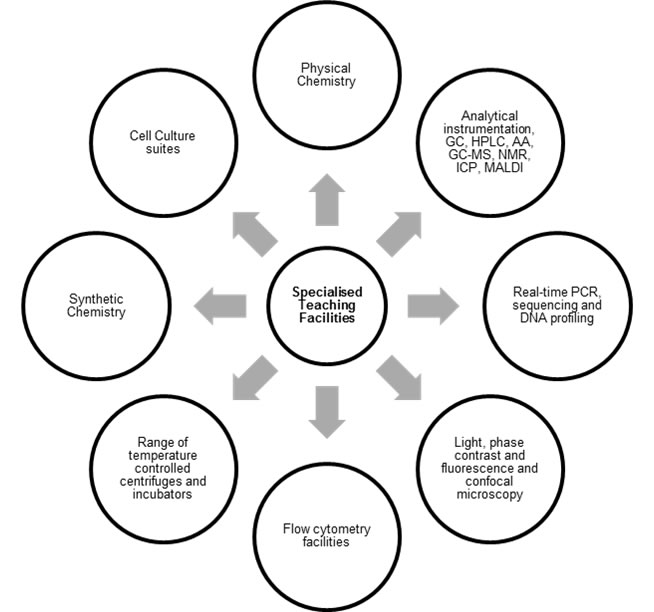
Since we feel it’s important that students gain practical skills on equipment that they will be using on placement or after graduation, all teaching labs are well equipped with a range of industry standard equipment including spectrophotometers, microscopes, bench top centrifuges (including cytospins), ELISA plate readers, agarose and acrylamide gel electrophoresis, western blotting tanks, automatic single and multichannel pipettes.
More specialist equipment such as programmable PCR machines, RT PCR machines, microbiology incubators, fluorescent microscopes, LiCor gel analysis equipment is also available for use in the teaching labs and there is an extensive suite of analytical instrumentation including 17 HPLCs, 7 GCs, 5 FPs, 3 FTIRs, 2 GCMSs, 2 LC-TMS and 4 Atomic Absorption Spectrometers. In addition, the department has two cell culture suites dedicated to teaching, which together provide 11 laminar flow hoods and 14 CO2 incubators for the growth and manipulation of mammalian cells.
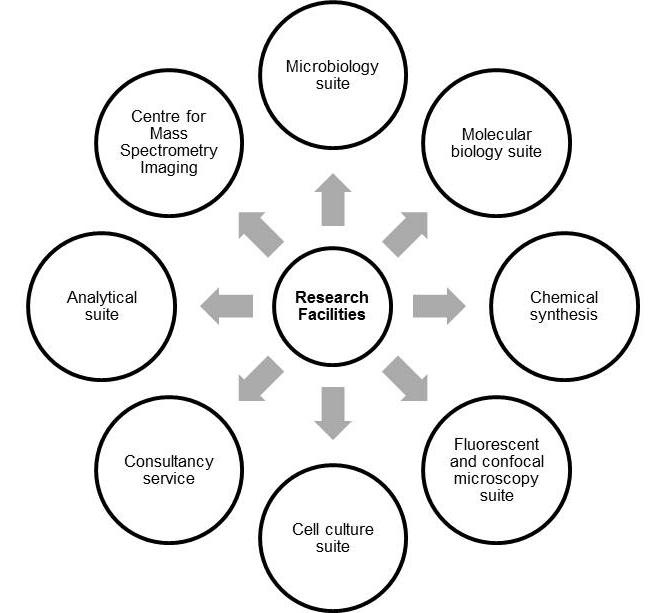
More specialised pieces of equipment are shared between teaching and research, but undergraduate and postgraduate students have access as necessary. This includes state of the art analytical instrumentation such as 8 mass spectrometers (both imaging and LC-TMS), NMR, ICP-MS and OES, ultracentrifuges, confocal microscope, cryostats, microtomes and flow cytometers.
The University has a capital equipment fund which it uses to maintain and evolve its equipment base. In the Department we have a 10 year capital plan, which identifies when key pieces of equipment will need replacing. For example we have recently purchased a new flow cytometer and Confocal Microscope.